 continued
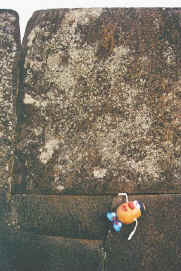
In search of other activity on the island, Spud found a group of archaeologists from the University of Chile that were in the process of restoring one of the many 'toppled' moai that litter the island. This long, difficult task required the use of a crane on loan from Japan to rebuild the immense altar, or ahu, on which the moai stand. Many of the cubes of rock that formed the ahu were in excess of fifteen tonnes and were carved to fit with precision as no mortar was used. Always eager to help, Spud tried to offer a helping hand and wound up getting it crushed when one of the multi-tonne blocks was dropped into place.
Nursing his wounded appendage, Spud opted for taking it easy for the rest of his stay on the Island. A little drained from the week's events, a local from the village of Hanga Roa suggested he pay a visit to Te Pito te Kura on the north coast of Easter Island. Te Pito te Kura is a large round rock that local legend states was brought to the island by King Hotu Matu'a in his canoe when he arrived from Hiva, the legendary homeland. The rock is to symbolize Easter Island (Rapa Nui) as being the 'navel of the world'. The boulder contains great power and emanates a strong force of energy to all that touch it. Eager to test the theory, Spud jumped on and soaked up as much juice as he could.
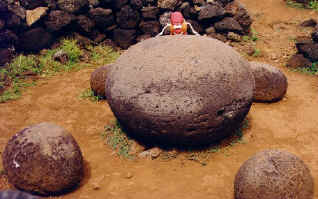
Turned out it was just a rock.
See more adventures on Easter Island